Women's healthcare is missing something important—your story.

A health initiative by:

Each of our hormonal journeys, from our first period to our last, is unique. We often share stories of our journeys with each other, but those stories, told in our own words, have never been brought together in one place where researchers, doctors, policymakers, and developers can learn from them.

The Magnolia Project is changing that. Not by asking women to fill out surveys, but by listening to their stories, in their own voices, with genuine care and scientific rigor.

Your story could help change women's health as we know it.

We are inviting women ages 40+ to share the story of their hormonal health journey, from their first period to now, in one confidential, 60 to 90 minute conversation.

Participation is voluntary at every step. You choose what to share, and you can stop anytime.
Your Unique Story  

Your hormonal health across
different chapters of your life
Heard, Not Surveyed

A real conversation, not a
questionnaire
Part of Something Bigger

Your story joins a growing
collection that researchers can learn from

Your hormonal health journey.

We follow your lead. You share what feels right. There are no wrong answers, and nothing is off limits.

We explore the full arc of women's hormonal health — not as separate moments, but as one connected life story.

Your Early Years

How you got your first period.

What you were told, and what you were not.

How you felt during this time, both the good and the bad.

Where and how you got information.

Transition to Adulthood

How your hormonal health experiences evolved over this time. Your story might include some, all, or none of the following experiences: contraception choices (if these were a part of your story, and how they made you feel), fertility ups and downs, pregnancy experiences and life afterward.

What your body did that surprised you, and how healthcare providers responded.

Perimenopause & Menopause

How the transition began and how you recognized it.

How these changes to your body made you feel.

If you decided to start new treatments, including hormone replacement therapy (HRT), and how it did or didn’t change things.

What you knew going in, what you wish you had known, and what you discovered along the way.

Your Experiences Getting Care

Provider relationships: what worked & what did not.

If you were ever diagnosed with something related to your hormonal health, what the process looked like.

Moments of being heard and/or moments of being dismissed.

What "good care" looks like to you.

Where & How You Get Information

Who you talked to.

What you read.

How the way you gather information has changed over time.

What you trust, what you question, and what you still cannot find answers for.

Connections Across Time

Looking back across your journey: patterns you've noticed in your own body, things you would have told your younger self, and questions about what your earlier health might mean for where you are today.

One interview. One piece of a much larger picture.

Every story adds something no other story could.

What one story can't show, a thousand can. Patterns emerge that no single story could reveal. Those patterns are shared with doctors, researchers, and people building new tools and treatments for women’s health.

ogether, we use those insights to improve how women are cared for. Over time, more women will join and add their voices. The more stories we have, the more patterns we see—and the better we can make women’s health.This is a data ecosystem designed to grow. This Phase I study builds the foundation of 180 interviews. In our next phase of research, we plan to scale to thousands across diverse geographies and backgrounds, with the technology needed to make real change at population scale.

Your story is the beginning of something much larger.

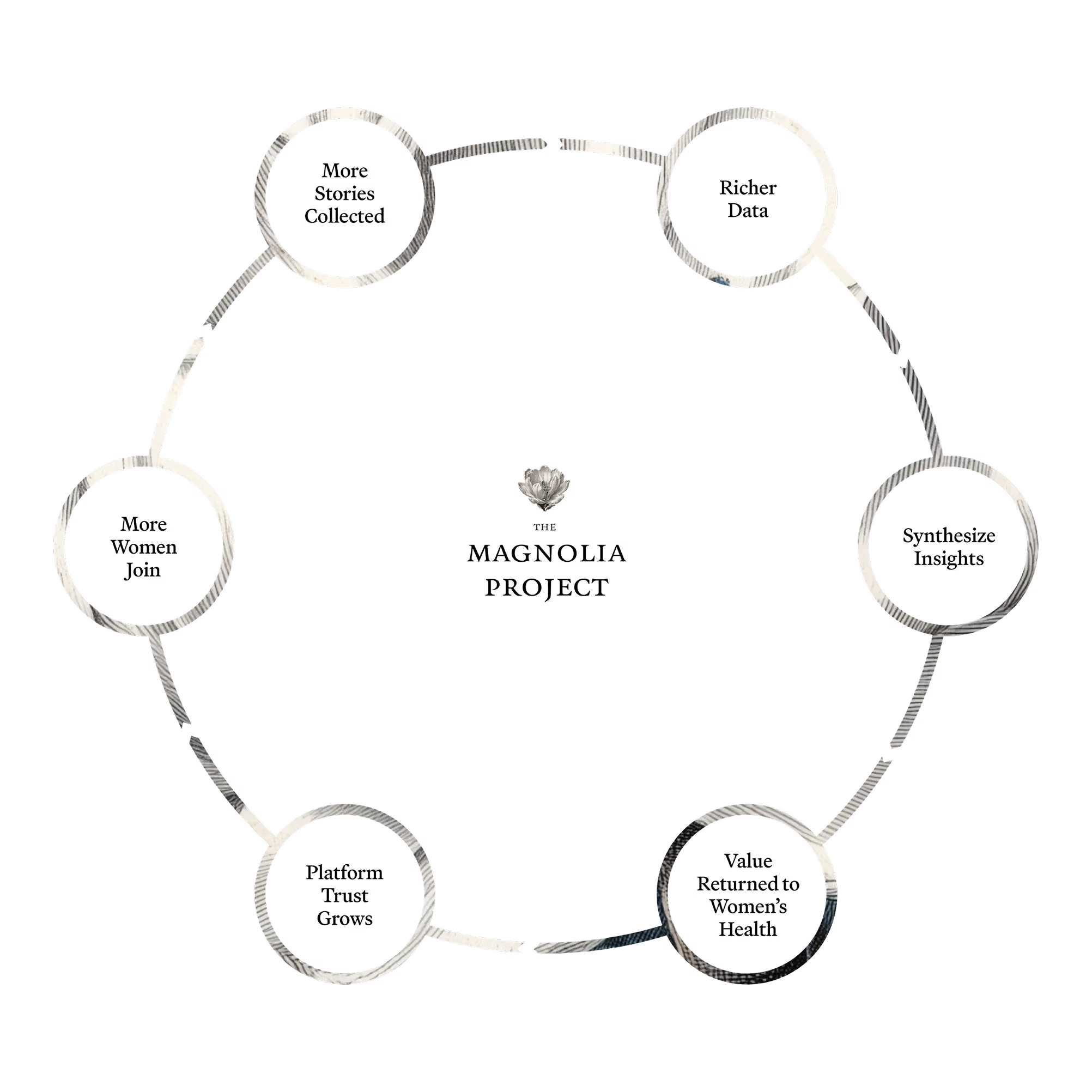
the magnolia project flywheel

The more stories we have, the more patterns we see. As we synthesize these insights value is returned, trust in the platform grows, and more women join. There is power in numbers.

What to expect.

1

Express Interest

Please complete the brief screening form linked below to help us determine if you are eligible for the Phase I study. A team member will follow up to share whether or not you are eligible. If you are eligible, they will also share more information on what participating in the study means before you commit.

2

Review + Consent

If you are eligible, you will receive a study information sheet covering the purpose, procedures, risks, and benefits of participating in the study. Participation is voluntary and you may withdraw anytime, for any reason, no questions asked.

3

Register for the Study

If you consent to joining the study, you will be asked to fill out a short survey, which takes around 5 to 10 minutes, to tell us a bit about yourself.

4

Schedule your Interview

After filling out the survey, a team member will reach out by email to help you find a time for your interview. The interview will be a video call that takes place over Zoom.

5

One Conversation

During the interview, you will have a 60 to 90 minute conversation with a trained interviewer. The conversation is confidential. You share what you are comfortable sharing. There are no required topics and no right or wrong answers. You can take a break or stop at any time.  Whatever your story includes is welcome here.

6

Your Impact

Your story joins a growing dataset analyzed for patterns across women's health.  Findings will be shared with doctors, researchers, and people working on new tools and treatments to improve how women's health is understood, studied, and treated, for this generation and the next.

How we protect
your privacy.

The Magnolia Project is committed to the responsible and ethical conduct of research. Your participation is voluntary and your data is protected.

Your Control

You choose what information you want to share. You may decline any question, and you may withdraw your data after your interview. Participation will not affect your medical care or any healthcare provider relationship.

Your conversation will be with a trained interviewer. They are trained to handle sensitive topics, confidentiality, and your well-being throughout your interview.

Data Protection

Your interview recording is stored in a secure, password-protected database. Anyone who can access your personal information must sign agreements to commit to keep your information private. We use secure, well-known tools to store and manage your information, including Google Workspace, Zoom, Claude, and DocuSign. If there is ever a security problem that we think could affect you, we will let you know.

Ethics & Informed Consent

This study meets the highest standard for ethical research. It has been reviewed and approved by the North Star Review Board, a committee which independently oversees research involving people.   You will receive a full description of what participating in the study means before any data is collected. You will be asked to provide written consent before sharing any data.  You have the right to withdraw at any time without any penalty for stopping.

Answers to common questions.

1

Who is eligible to participate?

We are inviting people ages 40+ who have ever had a period and who are willing to share their personal health experiences across their life span. Your experience, whatever it has been, is what we want to hear.

2

Is participation voluntary? Can I withdraw?

Yes, participation is entirely voluntary. You may decline to answer any question during the interview, and you may withdraw from the study at any time before, during, or after your conversation, without penalty or explanation required.

3

How will my data be used?

Your interview will be recorded and transcribed. We will remove information that could directly identify you, like your name, before we analyze your data during our Phase 1 study. We will analyze the interview transcript alongside other participants' interviews to identify patterns across women's health experiences. Findings may be used to inform research, care, education, and health policy.

Beyond the Phase 1 study, your interview will be stored as part of The Magnolia Project's long-term databank. This means it may be used for research long into the future, including research we have not yet planned, by researchers and organizations we have not yet worked with. Your data could be used by commercial partners to develop new treatments or tools for women’s health.

4

Who will hear or read my interview?

During this Phase 1 study, access to recordings and transcripts is primarily limited to authorized members of the research team. All team members have signed agreements to keep your information confidential.

‍

There are some situations where we may need to share information about you.

  • If we are worried about your safety or the safety of someone else
  • If we are required to by law
  • For auditor and Institutional Review Board oversight purposes

‍

Beyond the Phase 1 study, you will have the option to decide whether you want your interview to be used by future researchers. This is your choice. You can say yes or no. Saying no will not affect your ability to take part in this study.

5

What topics will be covered?

The interview covers your experiences across childhood, adulthood, and perimenopause/menopause if you have reached that point in your life. The interview will also cover your interactions with healthcare providers and how you have sought health information over time. You share only what you are comfortable sharing. We will also provide space for you to discuss other meaningful parts of your hormonal health journey that may not fit cleanly into any of these buckets. There are no required answers, and you may skip any topic at any time.

6

Will my employer, doctor, or insurer be notified?

No. Your participation in this study is confidential and will have no effect on your employment, your medical care, or your insurance.

7

Is there any risk to participating?

The primary risks are emotional. Some participants may find it uncomfortable or upsetting to discuss personal health experiences. You are not required to discuss anything you do not wish to, and you may stop the interview at any time.  More information about risks will be provided in your consent documentation before you start participating in the study.

Have a question about the Magnolia Project?

If you would like more information before signing up for the study, or if you want to get in touch with the study team for any other reason, leave your contact info and your questions and someone from our team will get back to you promptly.

submit

By submitting this form, you consent to us collecting the information you’ve shared to provide additional information about the Magnolia Project.

Thank you! Your submission has been received!
Oops! Something went wrong while submitting the form.

Why Magnolia:
Ancient Wisdom

nobility + dignity
The majestic appearance of the magnolia tree and its large, fragrant flowers associate it with high status and grace. 

perseverance + strength
As an ancient and enduring plant, the magnolia symbolizes strength, resilience, and the ability to overcome challenges.

feminine energy + beauty
Magnolias are often linked to femininity and gentleness, representing womanly beauty.